
Select tickets

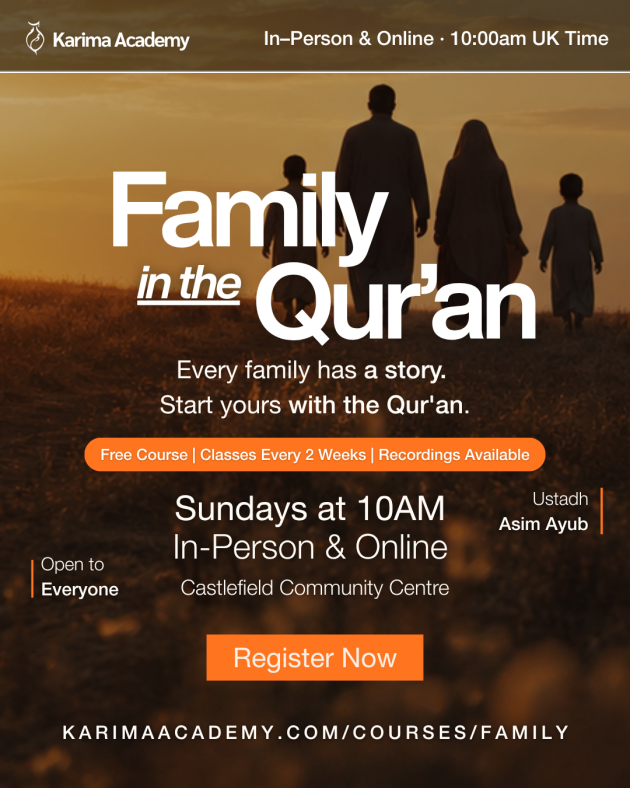
📍 The Family in the Qur’an: Stories
Lessons on building a family with love, loyalty, and legacy from the Qur’an.
🗓 Schedule:
- Every 2nd and 4th Sunday of each month
- 10:00 AM – 11:30 AM (UK time)
- In-person at Castlefield Community Centre, High Wycombe, HP12 3LL
📱 WhatsApp Group:
To receive class reminders, updates, and resources, you must join the WhatsApp notification group.
The link to join is included in your confirmation email.
The Family in the Qur'an — Autumn Term 2026
A father speaks to his son. Are you the father, or the son?
This term we walk verse by verse through the advice Luqman gave his son (Surah Luqman 31:14–19), then into the new year with the last words between Nūḥ and his son at the ark (Surah Hūd 11:42–47). Each fortnight takes one verse and asks it from both sides: what it demands of parents, and what it demands of children — what you owe your mother, when you may say no to your parents, how to live when nobody's watching, how you speak and carry yourself, and what happens when a child decides to go his own way.
Sessions
1. Weakness upon weakness (31:14) — Maternal struggles in the modern age: exhaustion, isolation, regret that mothers rarely say aloud, and the cases where it breaks. Then we begin a reflection that runs through the whole term — why the Qur'an chose the mother, at her weakest, as the image of Allah's mercy.
2. Your mother, your mother, your mother (31:14)— The rights of parents through the narrations: the man who carried his mother round the Kaʿba, Uways who never met the Prophet because he was caring for his, the young man told "stay with her, Paradise is beneath her feet." And the other side — what a mother owes her child.
3. When parents oppose you (31:15) — The one place the Qur'an tells you not to obey your parents, and what it tells you to do instead. Saʿd's mother refusing to eat, Asmāʾ's polytheist mother, Ibrāhīm and his father. How far obedience goes, and how to say no without cutting the rope.
4. The mustard seed in the rock (31:16) — Nothing is hidden from al-Laṭīf. What it means to raise — and to be — a child who behaves the same alone as in company: the shepherd who wouldn't sell the sheep, the girl who wouldn't water the milk.
5. Prayer, good, wrong, and patience (31:17) — Four habits Luqman gives his son in one breath. Why prayer comes first, how to speak up for good inside your own home without nagging, and why patience is named as the thing that takes real resolve.
6. Do not turn your cheek (31:18) — Pride in the body: the turned face, the strut, the eye-roll, the phone in the hand while someone speaks to you. Contempt between parents and children, siblings and relatives — and the Prophet who turned his whole body to whoever addressed him.
7. Lower your voice (31:19) — Luqman ends with how you walk and how you speak. Shouting as a household culture, the tone children inherit, and the man who served the Prophet ten years without hearing "uff."
8. Board with us, my son" (11:42–43) — Nūḥ calls his son onto the ark; the son says he'll climb a mountain. Nine hundred and fifty years of calling, and the one he most wanted to save says no. The child who trusts his own plan, and the limits of what any parent can do.
9. "He is not of your family" (11:45–47) — Nūḥ pleads: "my son is of my family." Allah answers: he is not. What actually makes someone family — blood or righteousness — and how a parent who did everything right is taught to grieve, ask, and submit.
The Messenger of Allah ﷺ said:
“Verily, this Qur’an is a rope. One end is in the hand of Allah and the other end is in your hands. Hold fast to it, for you will never be led astray or ruined ever again.”
(Sahih Ibn Hibban)
The Qur’an is filled with stories of families — their struggles, sacrifices, and the bonds that shaped history.
From devoted fathers and supportive brothers, to heartbroken parents and disloyal spouses, the Qur’an lays out the full spectrum of family life — both its beauty and its challenges.
In this course, we’ll explore these timeless stories to discover what it takes to build families rooted in the love of Allah — and how to avoid the pitfalls that tear them apart.
📖 Topics include:
- The advice of Luqman (peace be upon him) to his son
- Ibrahim (peace be upon him) and his father
- Ibrahim (peace be upon him) and his son Ismail (peace be upon him)
- The four archetypal women at the end of Surah al-Tahrim
- Musa (peace be upon him) and Harun (peace be upon him) – brothers in prophethood
- Maryam (peace be upon her) and Isa (peace be upon him) – a miraculous mother and son
- Nuh (peace be upon him) and his son – the heartbreak of disbelief within one’s own family
- Adam (peace be upon him) and Hawwa (peace be upon her) – the first couple and the human story of repentance
- Musa (peace be upon him) and his mother – maternal trust, courage, and Allah’s protection
👤 Instructor
Asim Ayub is a qualified Islamic scholar with an Alimiyyah degree from Darul Uloom Bury, and also holds academic credentials in Economics and Economic History.
He teaches Islamic sciences and delivers lectures on contemporary spiritual and ethical issues at Karima Academy and various educational institutions.